DG - FROM PALIMPSEST TO ANAGRAM
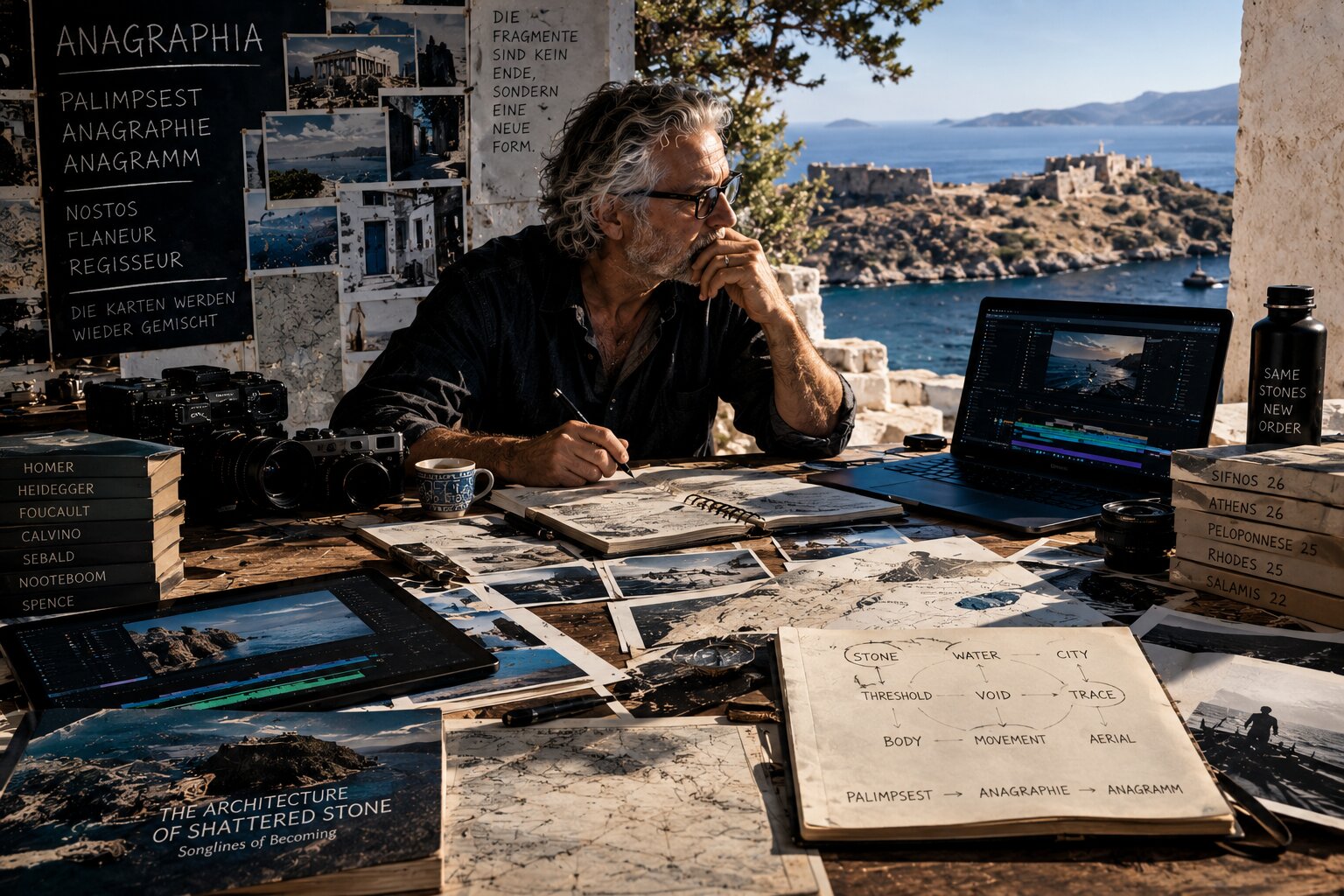
Continuation of:
Synopsis
Nostos, the Flâneur, and the Regisseur: Reconfiguring the Shattered Archive
The text is about the decisive transformation of travel into authorship: the Flâneur returns from the journey not to recover a lost home or reconstruct a coherent past, but to confront the fragments the journey has produced—places, images, stones, memories, notes and unfinished identities—and turn them into cinematic form. Palimpsest → Anagraphia → Anagram describes this movement from accumulated layers, through active re-inscription, to radical recomposition: the same material is no longer archived or documented chronologically but cut, displaced and montaged into a new visual constellation. Nostos becomes montage; the journey becomes material; the archive becomes a cinematic score. The goal is therefore not to reconcile the fragments or repair the biography, but to exercise the sovereignty of the Regisseur: to take what already exists, reorder its relations, and make a new world from the shattered pieces. Pasted text
From Palimpsest to Anagram:
The Cinematic Recomposition of the Shattered World
The text deconstructs the romantic myth of Nostos—the sentimental homecoming to a preserved origin—and redefines return as a radical confrontation at the editing table. Tracing an existential and methodological triad from the Palimpsest (the passive accumulation and overwriting of travel notes and archives) to Anagraphia (the deliberate, defiant inscription of the solitary body and raw stone into the widescreen frame), the work culminates in the Cinematic Anagram. The ultimate goal of this late sovereignty is not to invent new material or mourn half a century of discontinuous fragments, but to operate as an uncompromising director: seizing the identical, unalterable spolia of a life—the 1,500 static takes, the maritime voids, the bastions, the silence—and dismantling their chronological syntax. Through the violent collisions of montage, the journey ceases to be an archival record of the past and transforms into an autonomous visual score, proving that freedom lies not in reconciliation with one’s biography, but in the power to reorder its coordinates into an entirely unforeseen world.
IV. From Palimpsest to Anagram:
The Regisseur as Cartographer of Becoming
Nostos, the Flâneur, and the Cinematic Recomposition of the Shattered World
The journey does not end with the return. Nostos is not the recovery of an origin, nor the arrival at a place that can finally be called home. It is the return with altered coordinates. The traveller comes back carrying fragments: images, stones, passages, faces, horizons, sentences, the memory of wind and salt. What was once experienced as a sequence of disconnected episodes begins to reveal another kind of continuity—not a line, but a constellation.
This is where the Palimpsest gives way to the Anagraphia.
The landscape is no longer simply traversed; it is written into again. Every journey leaves inscriptions, but the traveller also returns to the material and rewrites it through memory, image and thought. The Aegean is therefore not merely a geographical space but a writing surface. Sifnos, Athens, the Peloponnese, the ports, fortresses and islands become layers in a continually rewritten map. The Flâneur moves through them without the obligation to arrive at a predetermined meaning. He walks, observes, waits, records. He collects fragments without yet knowing what they will become.
But the Regisseur begins where the Flâneur stops.
The camera takes possession of the fragments.
A wall becomes a cut. A horizon becomes a duration. A body crossing a courtyard becomes a scale against stone. The sea becomes a transition rather than a landscape. A ruin is no longer evidence of the past but a cinematic surface upon which another time can appear. The Regisseur does not reproduce the journey; he recomposes its remains.
This is the movement from Anagraphia to Anagramm.
The material does not need to be supplemented. Nothing essential is missing. The same stones, images, memories and experiences are sufficient—but their order can change. Like letters in an anagram, the elements of the journey can be displaced until another configuration emerges. Montage becomes the decisive gesture: not accumulation, but rearrangement; not explanation, but collision.
The film therefore becomes a second journey.
The first journey crosses geography.
The second crosses the archive.
In the first, the Flâneur follows the Songlines of the world. In the second, the Regisseur follows the invisible lines between images. Nostos becomes montage. The return is no longer a return to where one began, but a return to the material itself—to look again, to cut differently, to discover that what appeared to be fragments may have been coordinates all along.
Perhaps this is what late sovereignty finally means: not to possess one's past, but to become capable of reordering it.
The shattered stone remains shattered. The archive remains incomplete. The journey remains discontinuous. But the fragments no longer demand reconciliation. They demand composition.
Palimpsest → Anagraphia → Anagramm.
From accumulated layers, to renewed inscription, to radical recomposition.
And somewhere between the traveller and the filmmaker, between Nostos and the Flâneur, between the open horizon and the editing timeline, a new figure appears: neither the man who has finally arrived nor the man who is still searching for home, but the one who has learned to make a form from his trajectory.
The journey becomes the material.
The material becomes the image.
The image becomes the cut.
And the cut becomes a world.
IV. From Palimpsest to Anagram:
The Director Behind the Songline
Nostos as Montage, Not as Homecoming
What began as a songline ( SONGLINES OF BECOMING - THE PATH OF ORPHEUS / DG - CASA DEL VIGNAIOLO - SONGLINES OF BECOMING ) reveals itself, in retrospect, as a palimpsest: every coastline crossed, every strait sailed through, carries beneath it the layer of an earlier journey—overwritten, but never erased. The flâneur who moves through Hydra, through the lanes of Nafplio, across the bastions of the Peloponnese, first reads only these layers—an archaeological gaze that uncovers past beneath present. But the mere flâneur remains a consumer of his own past. The real work begins only when reading turns into writing: when the fragments—light traces, stones, notes, frames—are no longer merely uncovered, but actively re-inscribed. This is the hour of anagraphia: the traveler stops simply documenting what was and begins binding himself to what shall be. Nostos loses its old meaning here as a return to a place; it becomes a homecoming into a form.
This form does not take shape on paper alone, but in the viewfinder. The flâneur who sees transforms into the director who composes. Where the songline was once the trace of a path, it becomes, under the director's hand, a shot, a cut, a montage—every ruin, every light trace on the water, every body in space becomes a building block of a work that no longer depicts the journey, but rearranges it. Here the final step of the chain unfolds: from palimpsest, through anagraphia, to anagram. The same spolia—the same places, the same masks, the same half-finished drafts of half a century—are no longer merely gathered or inscribed, but radically reordered, until an entirely different work emerges from identical material. The director behind the camera no longer asks where the stones came from. He only asks which wall they should carry today.
IV. The Mechanics of Reconfiguration: From Palimpsest to the Cinematic Anagram
Nostos, the Flâneur’s Gaze, and the Director’s Cut
The movement through shattered stone ( DG - The Architecture of Shattered Stone ) reaches its inevitable crisis at the editing table. Returning from the south is never an arrival; it is the realization that the classical Nostos—the sentimental homecoming of the weary voyager—is an impossible fiction. The flâneur does not walk to return to a preserved origin, but to expose the fiction of continuity.
For decades, the mind functioned as a Palimpsest: endlessly scraping away previous iterations of the self only to overwrite them, piling notes upon notes, travel upon travel, allowing old identities to bleed through half-erased parchment. But accumulation is not cinema, and memory is not form.
The transition from traveler to author demanded an Anagraphia: the counter-inscription. It meant carving the presence of the solitary figure directly into the 2.39:1 frame—a silent body standing before the bastions of Methoni, an unyielding measurement against the horizon. The lens ceased to record scenery; it etched an existential inventory into stone and salt, registering the breaks rather than concealing them.
Yet the final sovereignty of the director requires a further, more violent turn: the Anagram.
An anagram adds no new letters. It invents no artificial elements. It takes the identical, unalterable fragments of a life—the 1,500 static shots, the abandoned ports, the wind-battered alleys, the silence of the subject—and shuffles their syntax completely. The chronological journey from Sifnos, to Athens, to the Saronic Islands and the Peloponnese is destroyed. In its place arises an autonomous visual fugue where a stone wall collides with an aerial void, where a step in Piräus lands decades later in an empty harbor.
To direct is to cease archiving what happened. It is to seize the existing fragments, rearrange their immutable coordinates, and force the scattered syllables of the past to spell out an entirely unforeseen reality.
DIE TRANSFORMATION DER SPOLIEN (DE)
Vom Palimpsest über die Anagraphie zum kinematografischen Anagramm
Die Heimkehr (Nostos) erweist sich nach der Rückkehr an die Werkbank als Trugschluss: Der Flaneur kehrt nicht heim, um Vergangenes zu konservieren, sondern um die Illusion biografischer Kontinuität endgültig zu zerschlagen. Jahrelang glich das eigene Schaffen einem Palimpsest – einem endlosen Überschreiben und Schichten von Notizen, Archiven und Reisesplittern. Die anschließende Anagraphie setzte den ersten Widerstand: das unerbittliche Einschreiben des stummen Körpers in das optische Breitwand-Format, der Schnitt gegen das Vergessen.
Doch die späte Souveränität des Regisseurs vollendet sich erst im Anagramm. Das Anagramm erfindet kein neues Material. Es nimmt exakt dieselben vorgefundenen Bausteine – die 1.500 statischen Fragmente, die Steine, das maritime Vakuum, die eigenen stummen Blicke – und zerlegt deren chronologische Syntax kompromisslos. Nicht mehr die reale Reise wird dokumentiert, sondern ein neues Sprachgitter montiert. Aus denselben Elementen entsteht durch den harten Schnitt eine andere Welt: Das Archiv schweigt; die Partitur beginnt.